
The Ñeque of Panama: The Forgetful Gardener That Plants the Rainforest
It is small, shy and rarely stands still. Yet this golden-brown rodent may be responsible for some of the trees you admire in Panama’s forests. Meet the ñeque.
Tell a visitor to Panama to look out for wildlife, and they will scan the treetops for sloths, monkeys and toucans. Very few look down. But if you walk quietly along a forest trail in the early morning, you might catch a flash of orange-brown fur dashing across the leaf litter and vanishing into the undergrowth. That blur is a ñeque, and it is one of the most important animals in the Panamanian rainforest.
In this article, we will explore what the ñeque is, what it does all day, and why scientists and nature lovers are so fond of it. And at the end, we will show you the painting it inspired: a bold, red-and-turquoise canvas that turns this quiet forest character into a piece of art you can live with.
What Is a Ñeque?
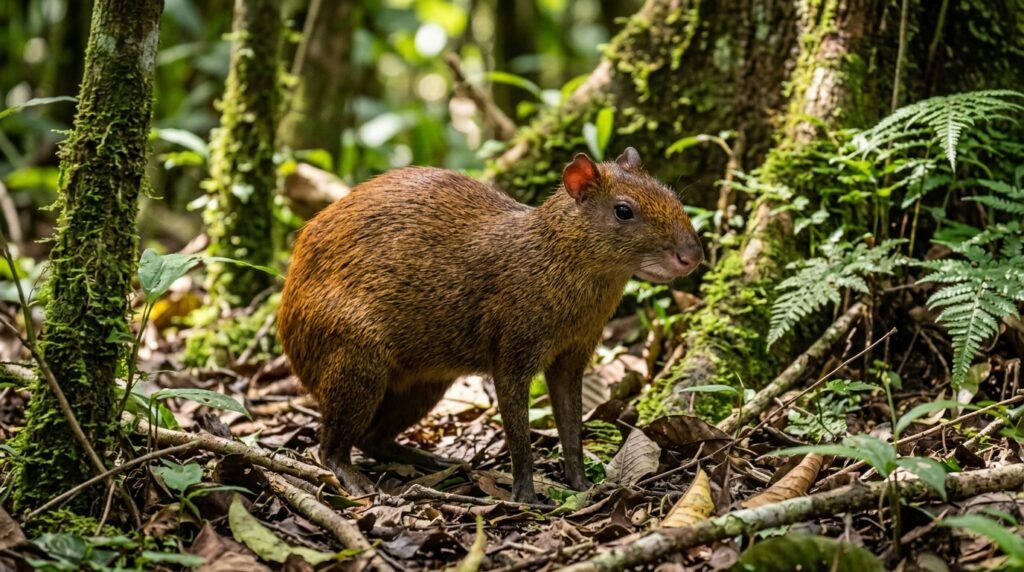
“Ñeque” is the name Panamanians use for the Central American agouti, a medium-sized rodent found in forests from southern Mexico down through Central America and into northern South America. In neighboring Costa Rica, people often call it guatusa. In English and in many scientific texts, it is simply the agouti. The word is thought to come from indigenous South American languages, which tells you how long humans have known and watched this animal.
The ñeque looks a bit like a long-legged guinea pig that has been to the gym. In fact, agoutis are distant relatives of guinea pigs and capybaras. An adult typically weighs a few kilograms. It has a compact body, slender legs, a very short tail and a coat that ranges from golden brown to rusty orange, often with a lighter belly. Its ears are small and rounded, its eyes are large and dark, and its nose twitches constantly, reading the forest for smells.
Its feet are another giveaway. The ñeque walks on the tips of its toes, which end in small hoof-like claws. That gives it a springy, delicate gait and lets it accelerate from a standstill to a sprint in a heartbeat.
A Day in the Life of a Ñeque
Most rainforest mammals are creatures of the night. The ñeque is different. It is largely active during the day, especially in the cooler hours of the morning and late afternoon. That is one reason it is one of the mammals most likely to be seen by walkers, hikers and birdwatchers in Panama’s forests.
A typical day starts with foraging. The ñeque moves slowly and carefully along the forest floor, sniffing for fallen fruit, seeds, nuts and tender plants. When it finds something worth eating, it sits upright on its haunches and holds the food in its front paws, nibbling with the neat concentration of a squirrel. It is hard not to smile when you see it.
Its diet is mostly fruit and seeds, with some leaves, roots and other plant material. It tends to stick to its home patch of forest, learning where the best trees are and when they drop their fruit. As the sun climbs and the heat builds, it often retreats to a sheltered spot, such as a hollow log, a tangle of roots or a shallow burrow, to rest until the air cools again.
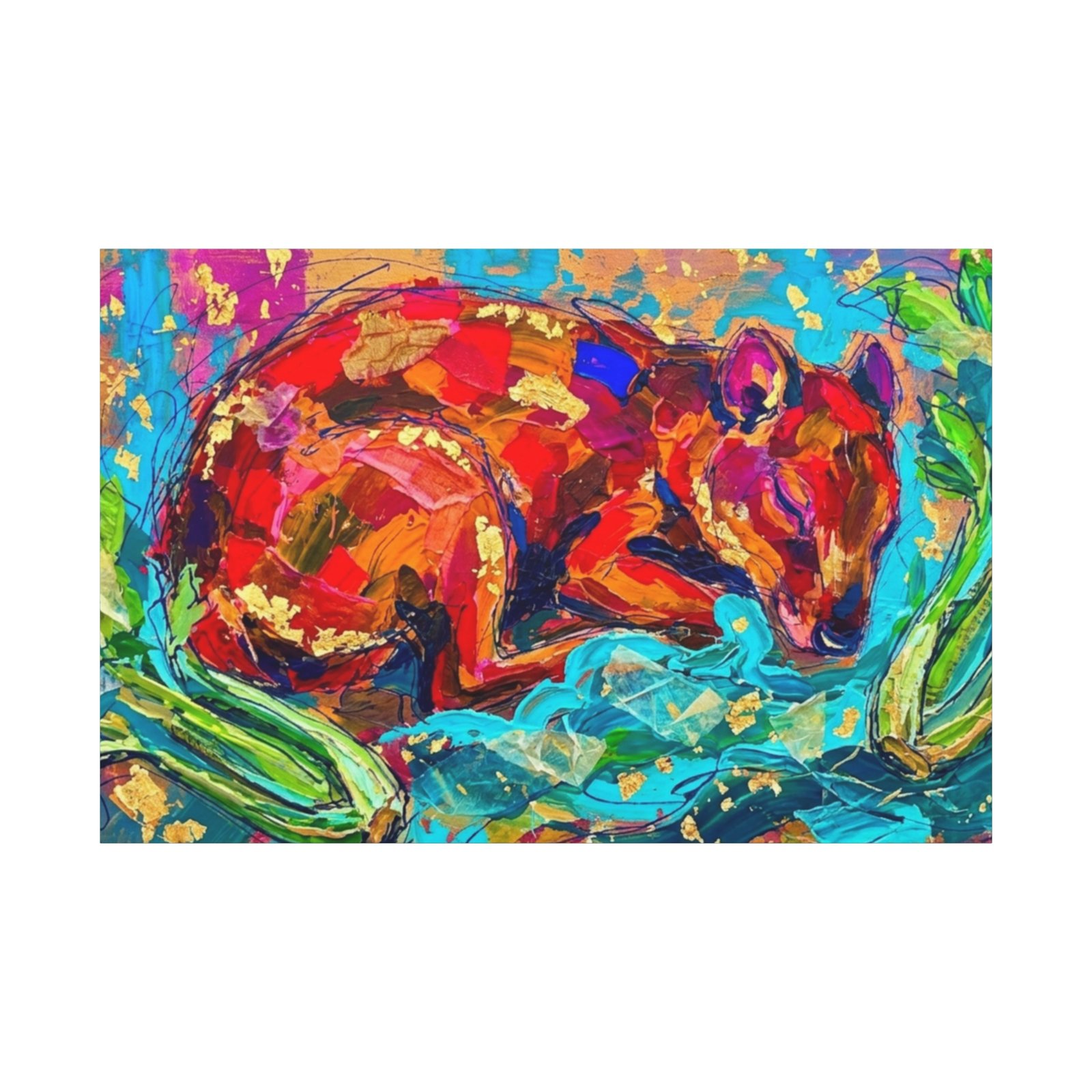
And that quiet resting moment is exactly the one our painting captures. A curled-up ñeque, nose tucked in, taking a break from the busy business of the forest.
The Great Seed Planter
Here is where the ñeque becomes truly remarkable. Every forest depends on seed dispersal: the movement of seeds away from the parent tree so they have a chance to sprout in new places. Some trees rely on wind, some on birds, some on monkeys and bats. Many large-seeded trees and palms rely on rodents like the ñeque.
The ñeque does something clever, and slightly forgetful. When fruit is abundant, it does not eat everything at once. Instead, it picks up seeds and carries them away, burying them one by one in small, scattered caches in the soil. This behavior is called scatter-hoarding. The ñeque plans to come back for its stash during leaner times, when food is harder to find.
But a ñeque cannot remember every hiding place. Some seeds are dug up and eaten later. Others are forgotten. And a buried seed that is forgotten is a seed that gets everything it needs: darkness, moisture and shelter from the animals that would eat it. In time, it sprouts. A tree begins to grow, sometimes far from the one that produced the seed.
Researchers working in Panama, including studies on Barro Colorado Island in the Panama Canal watershed, have documented how agoutis move and bury the seeds of large-seeded trees and palms. Some of those seeds have shells so hard that few other animals can open them. Agoutis have strong, ever-growing front teeth, and they can gnaw their way into seeds and fruits that defeat many other forest animals.
That is the secret of the ñeque. It is a gardener without knowing it. Every forest walk in Panama owes a little to its forgetfulness, and a healthy forest needs animals like it to keep renewing itself.
Fast, Alert and Always Ready to Run
Being a seed planter is a risky job. The ñeque is food for many of the forest’s predators, including ocelots, pumas, jaguars, large snakes and birds of prey. So it has evolved a range of defenses that make it one of the most alert animals in the forest.
First, there are its senses. Its large eyes catch movement at the edge of its vision, its ears swivel to catch tiny sounds, and its nose picks up scents on the breeze. When it senses danger, it freezes. If the danger comes closer, it explodes into motion, bounding through the undergrowth in zigzags that are very hard to follow.
Second, there is its voice. Agoutis can give sharp barks and alarm calls that warn others nearby. They also sometimes stamp their feet or raise the hair on their rumps when alarmed, which makes them look bigger. To a human watcher, it is part comedy and part marvel.
Third, there are its hideouts. Hollow logs, root tangles and burrows give it safe places to retreat. And that is part of why a sleeping ñeque, relaxed and curled up, is such a gentle image. It is an animal that has to be watchful almost all the time, and that rare moment of rest is precious.
Family Life: Pups That Hit the Ground Running
Ñeque pups are born in a very advanced state compared with many other rodents. They arrive with fur and open eyes, and they can start moving around within hours. A mother usually has small litters of one or two pups, which she raises in a sheltered spot in the forest.
This early independence is a survival strategy. A pup that can move quickly is a pup that can escape predators. And a small litter means the mother can focus her attention on keeping each baby safe. It is a quiet, careful kind of parenting, and it fits the personality of the animal perfectly.
Why the Ñeque Matters to Panama
Panama is a small country with an enormous amount of nature. As the land bridge between North and South America, it hosts a huge variety of habitats and species, from lowland rainforest to cloud forest, mangroves and dry woodland. Hundreds of mammal species and close to a thousand bird species share this narrow strip of land.
Inside that web of life, the ñeque plays a role that is easy to overlook and hard to replace. When it buries seeds, it helps trees spread to new areas. When it eats fruit, it helps maintain a balance among the plants of the forest floor. When it is hunted by predators, it passes energy up the food chain, feeding the big cats and eagles that people travel across the world to see.
The Central American agouti is currently considered a species of least concern, which is good news. But like many forest animals, it faces pressure in places where forests are cleared or where hunting is intense. The best way to protect animals like the ñeque is to protect the forests they live in, and to keep talking about why they matter. That is part of what wildlife art can do: it makes people notice animals they might otherwise walk right past.
From the Forest Floor to Your Wall
When we first thought about painting the ñeque, we did not want to make a scientific illustration. We wanted to capture how it feels to see one: a flash of warm color in a green and shadowy forest, a small animal that seems to carry the sunlight in its fur.
So we painted it in the hottest colors we could find. Crimson and orange for the coat. Touches of magenta in the ears and the face. Golden flecks catching the light across its back. And around it, a cool turquoise stream and fresh green leaves that make the warm colors glow even more.
The result is a curled-up ñeque, resting at the water’s edge, wrapped in color. The brushwork is thick and layered, and the surface has a textured, expressive look that makes the whole painting feel alive, even in its quietest moment. It is calm and wild at the same time.
What Makes This Canvas Special
Beyond its story, this canvas is made to be lived with. It is printed on high-quality canvas with UL-certified Greenguard Gold inks and stretched over a radiata pine frame from FSC-certified renewable forests. The inks are non-toxic, non-hazardous latex inks. It arrives ready to hang, with the hanging hardware on the back and soft rubber bumpers on the lower corners to keep it stable. At 60 by 40 inches and 1.25 inches deep, it is a generous horizontal piece with real presence.
Care is simple. If dust collects on the surface, wipe it gently with a clean, damp cloth.
Where to Hang a Statement Piece Like This
A large, colorful canvas can do the work of an entire room. Here are a few ideas for giving it the right home.
- Over a sofa or a bed. The wide horizontal format is made for the space above a long piece of furniture. It anchors the room and becomes the first thing people notice.
- On a gallery wall. Use it as the hero piece and surround it with smaller frames in neutral tones. The warm reds and oranges will stand out beautifully.
- In a creative studio or workspace. Color is energy. A bold painting keeps a workspace feeling alive and inspiring.
- In a kids’ room. A sleeping animal is a gentle, soothing image, and a great way to introduce children to Latin American wildlife.
- In an eclectic living room. If you love mixing patterns, textures and colors, this painting fits right in. Pick up the turquoise in a rug or a cushion and the room comes together.
One tip: let the painting lead. Keep the surrounding walls in calmer shades like cream, soft gray or warm wood, and let the reds, magentas and golds do the talking.
A Gift That Comes With a Story
Some gifts are forgotten in a week. A painting with a story is remembered for years. This canvas is a thoughtful gift for animal lovers, nature fans, housewarmings and travelers who have fallen in love with Panama. It is also a beautiful way for Panamanians living far from home to carry a piece of their country’s forests with them.
And the story is easy to tell. A shy forest animal that plants trees by forgetting where it left its seeds. Who would not want to hear that over dinner?
Let the Forgetful Gardener Into Your Home
The ñeque does not ask for attention. It moves through the forest in quiet bursts, gathers its seeds and rests when the day gets warm. And without ever meaning to, it helps the rainforest grow. It is a lovely reminder that small, patient creatures often do the most important work, and that rest is part of the job.
If you would like to bring a little of that calm and color into your home, the ñeque is waiting for you. Explore the piece below, and let it start a conversation on your wall.
Ready to see it in your space? Contemporary fine art, Vibrant artwork, Expressionist painting, Mixed media art, Textured wall art, Gold leaf art, Modern wall decor, Colorful home decor, Gallery wall inspiration, Statement art piece
Or browse the full collection for more color from Panama’s wild side.