
The Armadillo of Panama: A Little Armored Gardener of the Tropical Forest
How one shy, shell-covered animal ended up painted in turquoise and gold, and why it might be the most interesting thing you hang on your wall this year.
Ask most people to name the famous animals of Panama and you will hear the usual suspects: the harpy eagle, the sloth, the toucan, the golden frog. Almost nobody says armadillo. And that is exactly why this animal deserves a spotlight. It is quiet, it is odd, it is beautiful in its own armored way, and it does an important job in the forest that very few visitors ever notice.
In this article we will walk through the life of the Panamanian armadillo: what it eats, where it sleeps, why it jumps when it is frightened, and how it quietly shapes the forest floor. At the end, we will show you how all of that became a painting: a vivid, gold-flecked canvas that carries a piece of Panama into your home.
What Exactly Is an Armadillo?
The word comes from Spanish and means, roughly, “little armored one.” It is a perfect name. Armadillos wear a shell made of bony plates covered in tough skin, and the shell is divided into flexible bands across the middle so the animal can bend, twist and dig. No other mammal in the Americas looks quite like it.
Before Spanish speakers gave it that name, the Aztecs called it azotochtli, a Nahuatl word often translated as “turtle-rabbit.” Both names capture the same impression: a creature that seems assembled from parts of several different animals, and somehow works beautifully.
Armadillos belong to a very old group of mammals that evolved in the Americas. Their relatives include anteaters and sloths, which makes the armadillo a cousin of two other animals that Panama is famous for. It is a family reunion of the strangest, most charming mammals on the continent.
The Armadillo in Panama’s Forests
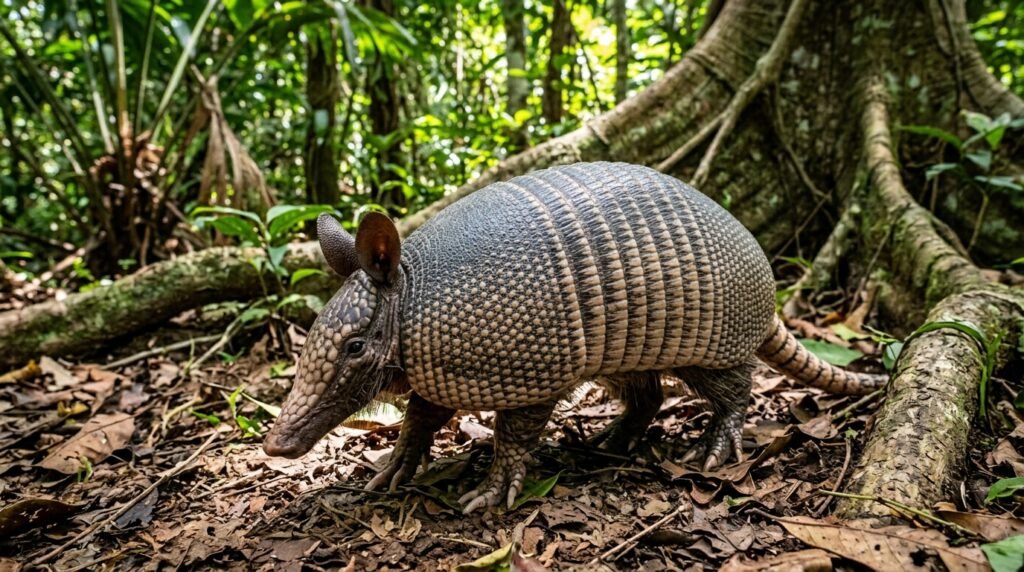
The species most travelers and locals are likely to meet in Panama is the nine-banded armadillo. It is a medium-sized animal, typically weighing a few kilograms, with a long pointed snout, small ears, a tail that tapers like a whip, and a shell the color of old bronze. Look closely and you will see the bands that give it its name, although the actual count can vary.
Panama is an ideal home for it. In a country this small, you can find lowland rainforest, cloud forest, dry forest, mangroves, rivers and farmland within a few hours of each other. Armadillos make use of many of these habitats, especially forest edges, wooded streams and areas with soft, easy-to-dig soil. The forests of the Panama Canal watershed, for example, are rich in wildlife, and animals like the armadillo move through them mostly after dark.
That is the first thing to understand about the armadillo: it keeps a quiet schedule. In many places it is most active at dusk and during the night, when the air cools and the forest floor is damp. It trundles along with its nose close to the ground, sniffing and digging, and it can be surprisingly hard to spot even in places where it is common.
A Nose Instead of Eyes
Armadillos do not see well. What they have instead is an extraordinary sense of smell. Their long snout works like a metal detector for food: it picks up insects, grubs and other small creatures buried beneath the leaf litter and soil. Then the armadillo digs with its strong front claws, flicking up earth and snuffling around the hole.
Most of its diet is made of insects, especially ants and termites, along with beetle larvae, earthworms and other small invertebrates. It will also eat fallen fruit, eggs and plant matter when the opportunity appears. This flexible menu is one of the reasons the armadillo has been so successful across a huge range of tropical and subtropical America.
Five Surprising Facts About Armadillos
Once you start learning about armadillos, it is hard to stop. Here are five facts that tend to delight everyone, from kids to biologists.
1. They can jump when startled
When a nine-banded armadillo is surprised, its first instinct is not to run or curl up. It leaps straight up into the air, sometimes high enough to hit the underside of a passing vehicle. It is a famous quirk, and it makes for one of the most charming reflexes in the animal kingdom.
2. They are excellent swimmers, and also walkers underwater
An armadillo is heavy for its size, so you would not expect it to cross rivers. But it can do it in two ways. It can gulp air to make itself more buoyant and paddle across. Or it can hold its breath for several minutes and simply walk along the bottom of a stream. For an animal in a country full of rivers, it is a useful talent.
3. They usually give birth to identical quadruplets
This one sounds invented, but it is true. A female nine-banded armadillo typically gives birth to four babies that are genetically identical to each other. A single fertilized egg splits into four embryos. It is such a reliable pattern that scientists have studied armadillos to learn more about development.
4. Their burrows help other animals
An armadillo digs several burrows within its home range. When it moves on, other animals often take over the empty holes for shelter. In that sense, the armadillo is an unintentional landlord of the forest.
5. They have a soft side
Despite the armor, an armadillo’s belly is soft and covered in hair. The shell protects its back and sides, but the animal is vulnerable underneath. When it feels threatened, it relies on digging, running or finding a hiding spot more than on curling into a ball.
The Forest Gardener Nobody Thanks
Here is where the armadillo becomes truly important. Every time it digs for food, it turns over soil, mixes organic matter into the ground and creates small pockets where rain collects and seeds can germinate. Multiply that by thousands of nights and thousands of animals, and you get a forest floor that is constantly being aerated and refreshed.
Its appetite for termites and ants also helps keep insect populations in balance. And because armadillos eat some fruit and move around widely, they may play a small role in spreading seeds as well. Nobody is going to put an armadillo on a postage stamp for gardening, but the forest would be poorer without it.
There is a gentle lesson here. The animals that make the biggest difference are not always the loudest or the most famous. Sometimes they are small, patient and discreet, working at dusk while the rest of us are asleep.
Panama, a Small Country With an Enormous Wild Side
Panama is the land bridge between North and South America, and for millions of years animals and plants have crossed it in both directions. That mix makes the country one of the most biologically diverse places in the Americas for its size, with hundreds of mammal species and close to a thousand species of birds.
Panamanians know this wealth well. Wildlife shows up on national symbols, in folk stories, in school lessons and in the names of towns and trails. When you see an animal painted in the colors of Panama’s forests, you are looking at a small piece of a very large natural inheritance.
It is also a reminder of why protecting that inheritance matters. The nine-banded armadillo is considered a species of least concern globally, which is good news. But habitat loss, roads and hunting pressure affect wildlife all over the tropics, and a healthy forest depends on every one of its quiet workers. The simplest thing most of us can do is learn about these animals, talk about them and, if we meet them in the wild, enjoy them from a respectful distance.
Why Wildlife Art Hits Differently
A photograph shows you what an animal looks like. A painting can show you what it feels like. Wildlife art has always done that: it condenses an animal’s personality, its habitat and its mood into a single image that you can live with every day.
That is why more and more people are choosing wildlife canvases over generic decor. A bold painting of a real animal gives a room a story. Guests ask about it. Kids learn from it. And if it comes from a place that means something to you, like Panama, it becomes a conversation starter and a memory in one.
The best wildlife art does not try to be a textbook illustration. It chooses color, texture and movement to capture the spirit of the animal. And that is exactly what happened with the armadillo you are about to meet.
Meet the Painting: The Armadillo in Turquoise and Gold
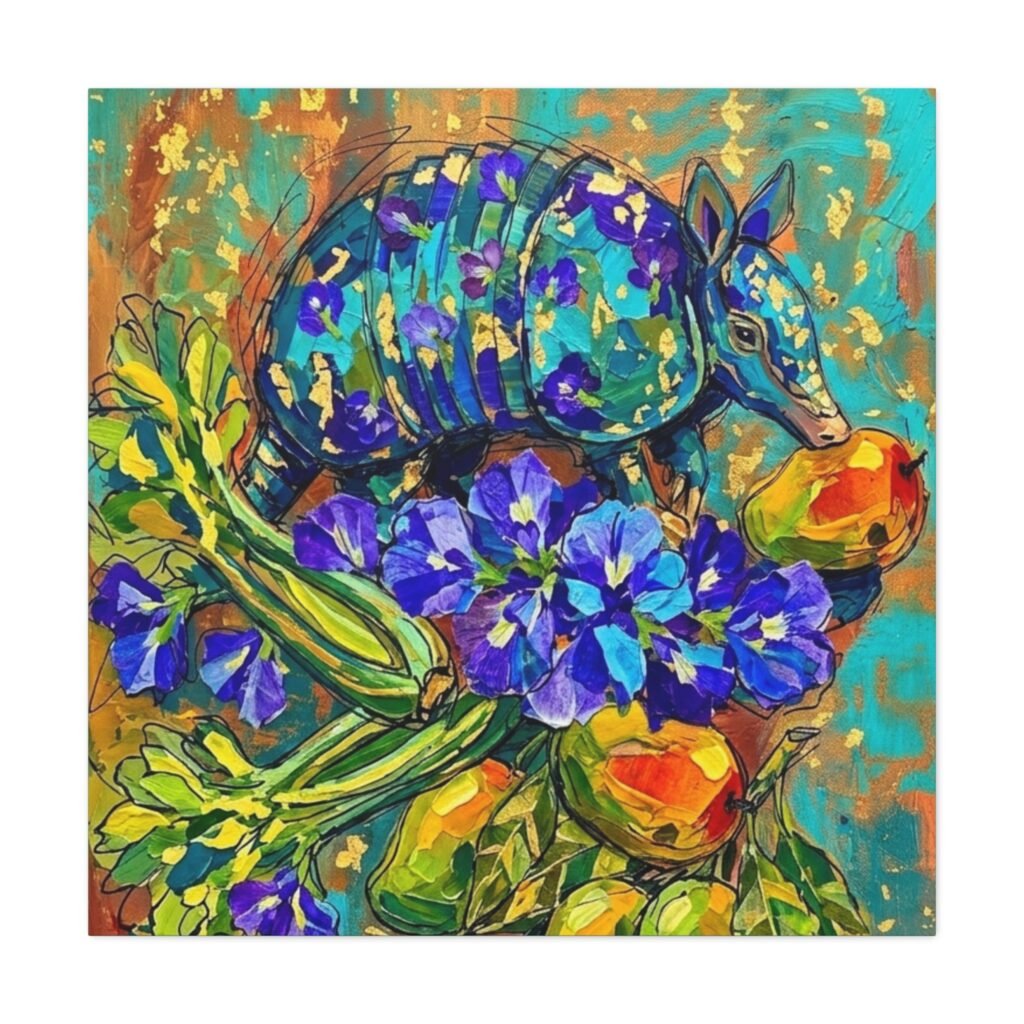
Imagine the armadillo not in the brown of the forest floor, but in the colors of the tropics at their most vivid. Its shell is a mosaic of turquoise and cobalt, speckled with flecks of gold that look like sunlight caught in leaves. Around it bloom blue flowers, green leaves and ripe fruit in coral and amber. The brushstrokes are thick, expressive and full of energy, so the whole scene seems to be moving.
The armadillo leans toward a ripe mango, nose first, exactly the way a real one follows its sense of smell. It is a small moment of curiosity, captured in paint. The turquoise background, the golden accents and the deep blue flowers give the piece the feeling of a jungle in motion: playful, warm and alive.
We made it for people who love animals, love color and love the idea of a story on the wall.
What You Are Getting
Beyond the story, the canvas is built to look good and last. It is printed on a matte cotton-polyester canvas and stretched over a sturdy radiata pine frame sourced from FSC-certified renewable forests. The inks are non-toxic latex inks, including Greenguard Gold certified inks. It arrives with hanging hardware on the back and soft rubber bumpers that help it sit steady against the wall. The piece measures 36 by 36 inches and is 1.25 inches deep, a square format with real presence.
Caring for it is easy. If dust collects, wipe it gently with a clean, damp cloth.
Where to Hang It: Six Ideas That Work
A 36-inch square canvas is a statement piece, so it deserves the right spot. Here are six places where the turquoise-and-gold palette really shines.
- Above the sofa. The square shape balances a wide sofa and gives the living room a focal point. Pick up one color from the painting in a cushion or a throw to tie it together.
- In the dining room. The coral and amber of the mangoes pair beautifully with warm wood tables and make mealtime feel festive.
- In the entryway. First impressions matter. A tropical animal greeting guests at the door sets a joyful tone for the whole home.
- In a kids’ room. Kids love animals, and a painted armadillo is a conversation starter that can spark a lifelong curiosity about wildlife.
- In a creative studio or office. Color is energy. A bold canvas keeps a workspace feeling lively and inspiring.
- In a reading nook. Pair it with a plant, a low lamp and a comfortable chair, and you have a small corner that feels like a tropical escape.
A quick styling tip: let the painting be the loudest thing in the room. Keep the surrounding walls and furniture in calmer tones, such as cream, wood or soft green, and the turquoise, cobalt and gold will pop.
A Gift With a Story
Many people who buy wildlife art are not buying it for themselves. A canvas like this makes a memorable gift for animal lovers, travelers who have visited Latin America, housewarmings and anyone who has a connection to Panama. It also means a great deal to Panamanians living abroad: a piece of home that is colorful, proud and not a cliché.
The best gifts come with a story, and this one has plenty. You can tell the recipient about the quadruplets, the underwater walks and the little jump. They will remember the painting and the conversation.
Bring a Little Panama Home
The armadillo does not ask for attention. It moves quietly through the forest at dusk, nose to the ground, doing the small, patient work that keeps the world turning. It is a good reminder to slow down and notice the things that are easy to overlook.
If this article made you smile, or made you curious, then the painting will probably do the same for you every morning. It is bold, it is warm and it carries a real story from a real place.
Ready to see it on your wall? Shop the Panama Armadillo Canvas or browse the full collection for more color from Panama’s wild side.