
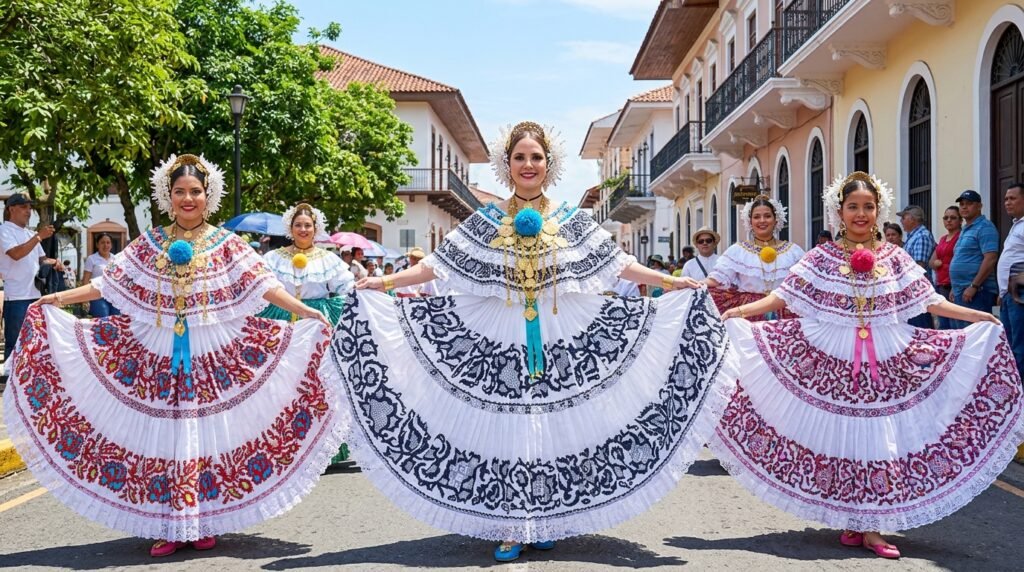
The Pollera: How Panama’s National Dress Turns Patience Into Art
It can take months to make, it is worn with gold and trembling hair ornaments, and it is considered one of the most beautiful national costumes in Latin America. Meet the pollera.
There are national symbols you see on flags and coins, and there are symbols you see in motion. The pollera belongs to the second kind. When a Panamanian woman walks into a plaza wearing a full pollera de gala, with its wide white skirt swaying, its jewelry catching the light and the tiny ornaments in her hair quivering with every step, conversation tends to pause. It is a dress that makes people look twice.
In this article, we will look at what the pollera is, how it is made, what each part is called and why it matters so much to Panamanians, at home and abroad.
What Is a Pollera?
The word pollera simply means “skirt” in Spanish, but in Panama it has come to name an entire traditional outfit. It is widely regarded as the country’s national dress, and it appears at festivals, parades, folk dances, weddings and school ceremonies throughout the year.
There are several styles. The most elaborate is the pollera de gala, the formal version worn on the most important occasions. Then there is the simpler pollera montuna, a lighter version with roots in the countryside. Regional variations exist as well, and the pollera santeña, associated with the Azuero Peninsula, is among the best known.
A Dress Made Stitch by Stitch
The first thing to understand about a gala pollera is that it is not bought off a rack. It is made by hand, usually by skilled seamstresses who have learned the craft over many years. The fabric is fine and white, and it is decorated with embroidery, lace and appliqué worked in patterns of flowers, leaves and geometric motifs. Every stitch is placed by hand.
That is why a single pollera can take months to complete, and sometimes more than a year for the most intricate designs. Because of the time and skill involved, a full gala outfit, with its jewelry, can cost thousands of dollars. Many families treat a pollera as a lifetime investment and pass it down through generations.
There is something quietly radical about that in a world of fast fashion. The pollera asks for patience, and rewards it with a garment that people remember.
The Anatomy of a Pollera de Gala
A full gala outfit is made of several pieces that work together.
- The blouse. A short, delicate top with ruffles and embroidery, often with a wide neckline that can sit off the shoulders.
- The skirts. Layers of wide, flowing skirts decorated with matching embroidery. When the wearer turns or dances, the skirt opens into a large circle, which is a signature move of Panamanian folk dance.
- The tembleques. These are the famous hair ornaments, made of delicate flowers, pearls and other small pieces mounted on thin springs or wires. They are called tembleques, which comes from the Spanish word for trembling, because they shiver with every movement. Worn in pairs or in large sets, they turn the wearer’s head into a small, sparkling garden.
- The jewelry. Gold chains, filigree earrings, medallions and crosses are layered across the neckline. In many families, this jewelry is inherited.
- The shoes. Traditionally, light slippers in a matching tone, made for dancing.
Together, these elements create a look that is formal, festive and very Panamanian, a balance of elegance and joy.
The Pollera Montuna: The Everyday Cousin
Not every pollera is a gala dress. The pollera montuna is a simpler outfit that grew out of rural life. It usually has a lighter blouse, a ruffled skirt in colorful fabric and fewer ornaments. It is easier to wear and to dance in, and it appears in many folk performances and school events.
Men have a traditional outfit too. The typical look includes a white shirt, light trousers and a straw hat known as the sombrero pintao, a woven hat decorated with dark patterns. By the way, the famous “Panama hat” is actually made in Ecuador. It got its name because many were shipped through Panama, and because they were widely worn by workers during the construction of the canal.
Where the Pollera Comes From
The pollera is a good example of how Panamanian culture blends. Its shape and its fine needlework show the influence of Spanish dress from the colonial era. But the story does not end there. Indigenous traditions and African heritage also shaped the way Panamanians dance, decorate and celebrate in these clothes, and local women adapted the style over generations until it became something unmistakably Panamanian.
That mixture is the heart of Panama’s identity. The country has always been a crossroads, where people and traditions from many places meet, and the pollera is a beautiful piece of evidence.
Where to See Polleras in Action
If you want to see polleras the way they are meant to be seen, plan your trip around the festivals.
- Las Tablas, in the Azuero Peninsula. This town is known as a center of pollera culture. Each year on July 22, Panama celebrates the Day of the Pollera, with parades, folk music and contests.
- Panama City, in January. A famous parade, known as the Desfile de las Mil Polleras (the Parade of a Thousand Polleras), fills the streets with women dressed in traditional outfits.
- Carnival. Polleras also appear in the parades and celebrations of Carnival, where they share the spotlight with queens, floats and music.
- Folk festivals around the country. Local fairs, school celebrations and religious festivals all offer chances to see the dress up close.
How to Appreciate the Pollera With Respect
If you are a visitor, you will probably be tempted to take photos. Most people wearing polleras are proud to be admired, but it is always polite to ask first, especially at private or religious events. If you are curious about the details, ask. Many wearers love to explain the meaning of their ornaments and the story of their outfit.
And if you ever think about wearing a pollera yourself, remember that it is a symbol of national pride and not a costume. Take the time to learn the traditions and, if possible, buy from local artisans who make them.
Why the Pollera Still Matters
In a time when so many traditions are fading, the pollera has stayed alive. Young women still choose to wear it, girls learn to dance in it, and Panamanians who live abroad often put one on to feel close to home. It carries history, family, craft and joy in a single garment.
It is also a reminder that beauty takes time. The most memorable things are rarely the fastest ones. They are made slowly, with care, by people who love what they do.
From Panama, with color
Bring a Piece of Panama Home
At Daryana Emyr we celebrate Panama’s color, wildlife and traditions with premium custom prints and personalized gifts. Find a piece that tells your story.
Explore the collection